
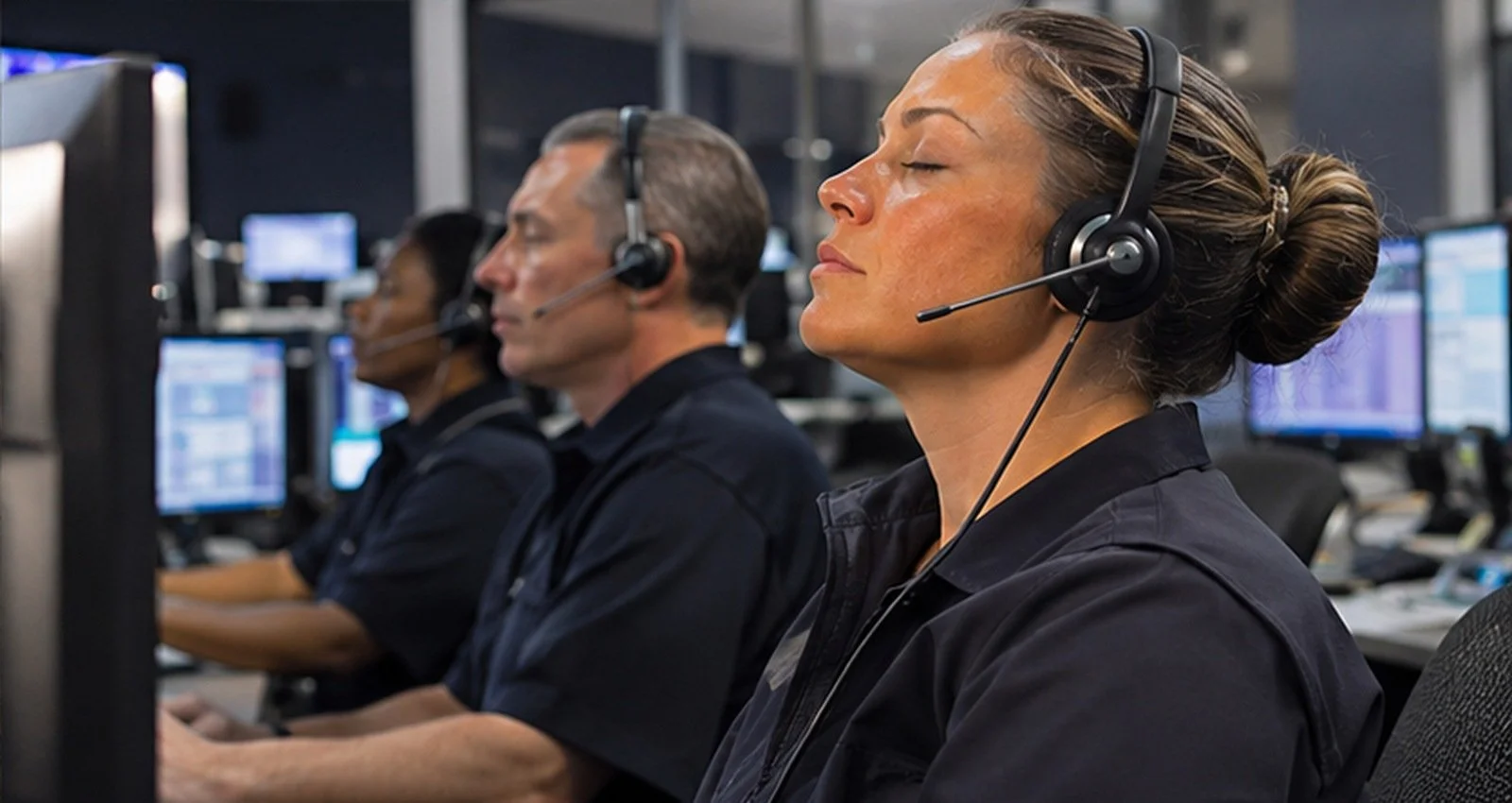
The invisible front line
Emergency communications professionals often hear a crisis before field responders encounter it. They must gather critical details, guide communication with callers, coordinate resources and remain accurate while another call may already be waiting.
In a qualitative study involving 23 police communications workers, participants described difficult calls, understaffing and supervisor-related pressures as workplace stressors. They also reported challenges involving sleep and other aspects of well-being. These findings help describe their experiences, although one study cannot represent every dispatch center.
Why dispatch creates a unique regulation challenge
Unlike responders in the field, dispatchers may face intense cognitive and emotional demands while remaining seated at a workstation. There may be little opportunity to process one difficult call before another requires full attention.
Brief moments of breathing awareness may offer a practical way to notice tension and refocus when circumstances permit. The aim is not to become deeply relaxed at the console, but to remain alert and responsive to the next task.
Breathing as a desk-compatible skill
When call volume and workplace policy allow, intentional breathing can be practiced at a workstation without special clothing or a long break. Begin by noticing posture and any tension in the jaw or shoulders, then follow a gentle breathing rhythm that feels comfortable. A guided session can offer structure when there is enough uninterrupted time; during live calls, normal duties always take priority.
Studies in broader populations suggest that some structured breathing practices may help with perceived stress. These findings do not demonstrate that any particular breathing pattern prevents burnout or trauma-related symptoms in 911 dispatchers, or that it improves performance during emergency calls.
Before, between and after a shift
Before the shift. If there is time before logging in, sit comfortably for one or two minutes, notice your breathing and any tension, and try a gentle, familiar pattern. The purpose is to arrive with greater awareness, not to force yourself to feel calm.
Between calls. Only when the center is covered and policy allows, release unnecessary jaw and shoulder tension and take a few comfortable breaths. Reorient to the next task without closing your eyes or diverting attention from incoming communications.
After the shift. Once relieved of duty, take a short, unhurried pause in a safe, stationary place. Notice how you feel, and, if comfortable, use a brief guided session before commuting or moving into personal time. This is an opportunity to mark the transition, not an expectation that all stress will disappear.
Support the person, not just the performance
Dispatcher well-being also depends on staffing, predictable opportunities for breaks, supportive leadership, peer connection, sleep and access to mental-health resources. Brief breathing practices may be useful within a wider support system, but should never be presented as a solution to organizational pressures.
Potential Benefits
Notice signs of building tension during long console shifts, such as a tight jaw, raised shoulders or rushed breathing.
Use a familiar breathing cue to bring attention back to the next task after a difficult call, when a safe pause is available.
Create a more intentional transition out of work mode by noticing and easing unnecessary tension after the shift.
Ideal For
911 dispatchers and call takers.
Emergency communications supervisors.
Agencies building wellness resources for personnel who are often left out of first-responder programs.
Where Respa Fits
Respa Mindfulness can help dispatchers practice a comfortable breathing rhythm before a shift, during an approved break or after duty. Guided sessions provide a clear pattern, and the wearable offers real-time feedback on how closely the user follows it. Respa is a mindfulness and biofeedback tool; it does not measure oxygen, carbon dioxide, lung capacity or heart-rate variability, and it does not diagnose a medical condition.
A Note on Safety
Use guided breathing only during off-duty time or an approved, operationally safe break. Do not use the app or wearable when it could distract from calls, monitoring, driving or other safety-critical duties. Stop if a breathing pattern causes dizziness, air hunger or discomfort. Persistent sleep, trauma-related or mental-health concerns deserve appropriate professional support.
References
Perez RA, Jetelina KK, Reingle Gonzalez JM. The Chronic Health Effects of Work-Related Stressors Experienced by Police Communications Workers. Saf Health Work. 2021;12(3):365-369. doi:10.1016/j.shaw.2021.05.005. PMID:34527398.
Fincham GW, Strauss C, Montero-Marin J, Cavanagh K. Effect of breathwork on stress and mental health: A meta-analysis of randomised-controlled trials. Sci Rep. 2023;13:432. doi:10.1038/s41598-022-27247-y.
Keesee TL. Just Breathe: How Managing the Breath Helps Public Safety Make Mindful, Value-Driven Decisions at Work and at Home. Kendall Hunt; 2026.
Just Breathe podcast, hosted by Tracie Keesee. 2026.
Zaccaro A, Piarulli A, Laurino M, et al. How Breath-Control Can Change Your Life: A Systematic Review on Psycho-Physiological Correlates of Slow Breathing. Front Hum Neurosci. 2018;12:353. doi:10.3389/fnhum.2018.00353.
Balban MY, Neri E, Kogon MM, et al. Brief structured respiration practices enhance mood and reduce physiological arousal. Cell Rep Med. 2023;4(1):100895. doi:10.1016/j.xcrm.2022.100895.