
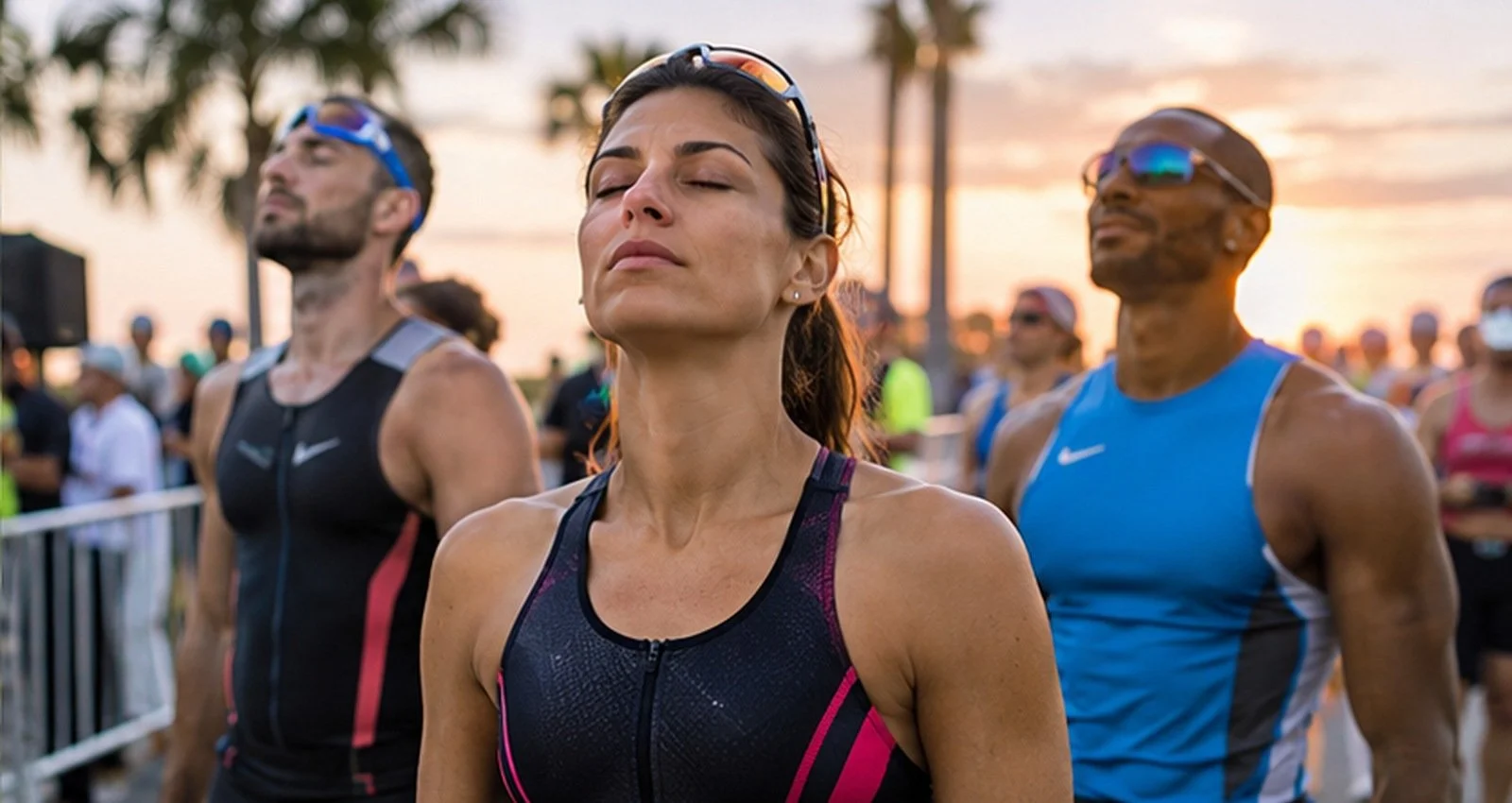
Why trained runners still get nervous
Runners can arrive well prepared and still notice a pounding heart, an unsettled stomach, racing thoughts, or an urge to keep moving before the start. Competition changes the context: expectations may feel high, and months of preparation come together on a single morning.
Feeling calm does not require having no nerves at all. Some activation can help athletes feel ready. The goal is to stay alert and able to follow a race plan, even when excitement or anxiety is present.
Breathing gives attention somewhere concrete to go
Before a race, attention can shift toward what might happen: pace targets, weather, competitors, the first hill, or the final miles. Following a comfortable breathing rhythm gives runners something concrete to return to in the present moment: the next inhale and exhale.
Research on slower breathing suggests possible effects on measures of autonomic activity and perceived stress. A 2023 meta-analysis found lower self-reported stress in breathwork groups than in control groups, while noting important limitations in the evidence. A small 2026 study of 34 adolescent American football players reported changes in one dimension of pre-competitive anxiety and in self-confidence after an intervention combining slow breathing with power posing. Because the study had no control group and combined techniques, it cannot establish the effects of breathing alone or show that the same results apply to runners.
A simple race-morning sequence
Start with the practical needs of race morning: hydration, nutrition, a bathroom stop, gear, and a physical warm-up. When it is safe and convenient, find a few uninterrupted minutes to follow a familiar, comfortable paced-breathing session. Afterward, return to natural breathing and notice what, if anything, feels different: jaw or shoulder tension, the pace of your thoughts, or the urge to rush.
The aim is not to make every uncomfortable feeling disappear. It is to practice noticing those feelings and choosing how to respond while staying connected to the task ahead.
Practice composure during training
A race-morning routine is more familiar when it has been practiced in advance. Try the same brief breathing session before selected workouts or a smaller race, instead of introducing a new pattern at the starting line. Over time, it can become a recognizable part of preparation rather than a last-minute attempt to get rid of nerves.
Potential Benefits
A simple attentional anchor before competition.
A familiar way to respond to normal pre-race activation.
An opportunity to practice composure without needing to eliminate nerves.
Ideal For
First-time racers.
Experienced runners who still experience strong starting-line nerves.
Athletes returning to competition after a long break.
Where Respa Fits
For runners who prefer guidance, Respa Mindfulness offers structured breathing sessions that can become part of a familiar pre-race routine. The wearable provides real-time feedback on how closely the user follows a guided breathing pattern. That feedback reflects the breathing practice; it does not measure anxiety or determine race readiness. Respa is a mindfulness and biofeedback tool; it does not measure oxygen, carbon dioxide, lung capacity, heart-rate variability, or diagnose a medical condition.
A Note on Safety
Choose a comfortable rhythm. Do not force long breath holds or an unusually slow cadence immediately before strenuous exercise. Stop and return to natural breathing if you experience dizziness, air hunger, pain, or marked discomfort. Breathing practice should complement, not replace, appropriate professional care for severe anxiety or panic symptoms.
References
Fernández-Barradas EY, Reynoso-Sánchez LF, Herrera-Meza S, López-Walle JM, Martínez-Moreno AG. Slow paced breathing and power posing: a pre-competitive ritual during an American football season. Front Sports Act Living. 2026;8:1800382. doi:10.3389/fspor.2026.1800382. PMID:42256048.
Zaccaro A, Piarulli A, Laurino M, et al. How Breath-Control Can Change Your Life: A Systematic Review on Psycho-Physiological Correlates of Slow Breathing. Front Hum Neurosci. 2018;12:353. doi:10.3389/fnhum.2018.00353.
Fincham GW, Strauss C, Montero-Marin J, Cavanagh K. Effect of breathwork on stress and mental health: A meta-analysis of randomised-controlled trials. Sci Rep. 2023;13:432. doi:10.1038/s41598-022-27247-y.