
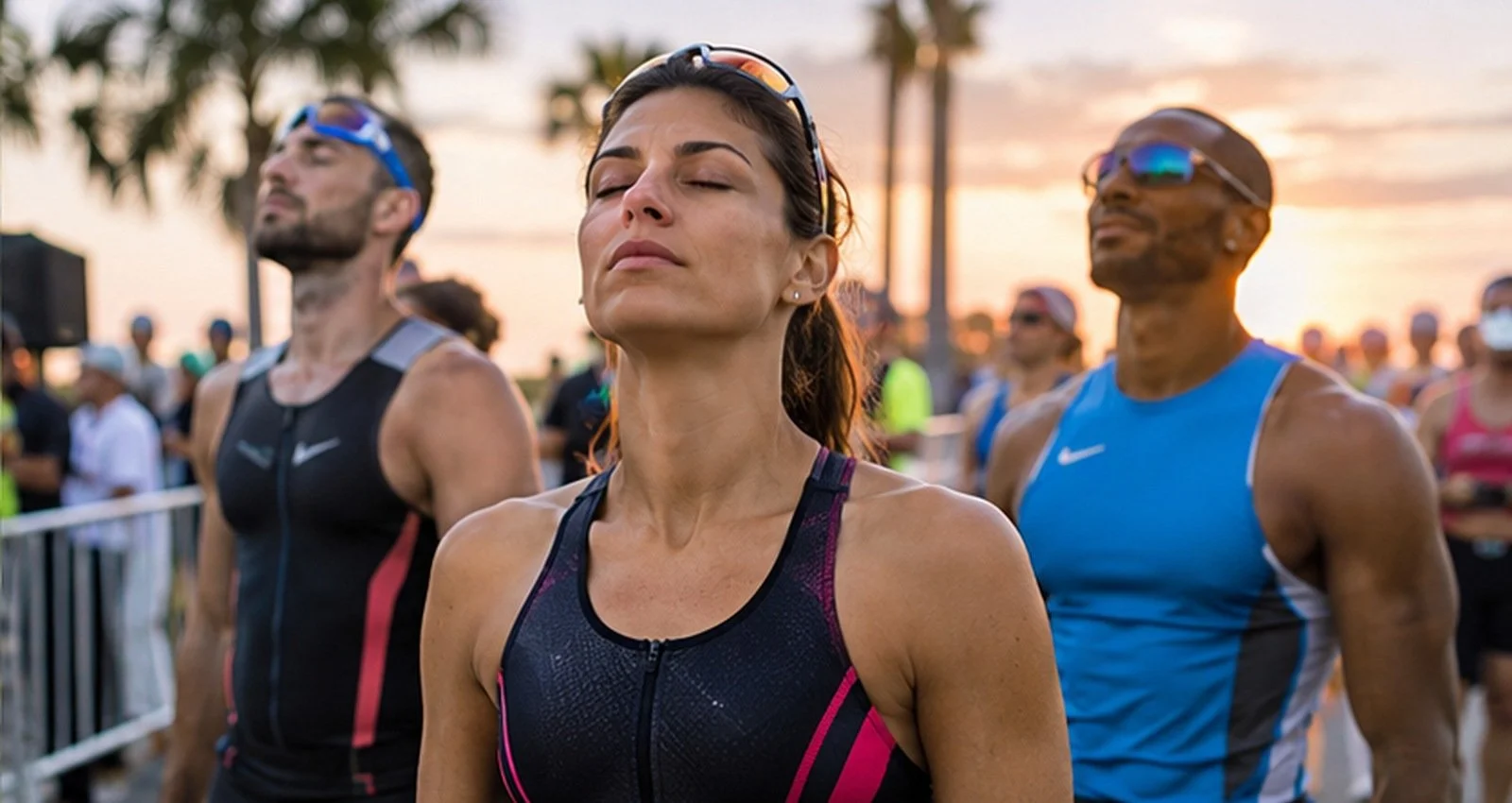
Triathletes train transitions—breathing is part of every discipline
A triathlon combines swimming, cycling, and running, with two transitions along the way. Breathing changes throughout the event: from finding a rhythm in the water to responding to effort on the bike and run. It can also feel different before the start, when anticipation is high.
That does not make guided breathing a literal fourth sport. It does make breathing awareness a useful skill to practice around training and competition.
Breathing practice is different from physical training
During hard exercise, breathing naturally speeds up to meet the body's needs. Athletes should not try to force a slow, relaxing rhythm while swimming, cycling, or running at high intensity. Structured breathing is better suited to moments before a session, after a physical cooldown, or away from peak effort.
Swimming, cycling, and running build cardiorespiratory fitness. Guided breathing serves a different purpose: it gives athletes a way to practice noticing their breathing, following a comfortable rhythm, and bringing attention back to the present. It complements, rather than replaces, physical training.
Where a breathing practice can fit
Before a brick workout (a bike-to-run training session), a short, comfortable Breath Up practice can become a familiar starting cue. After a demanding session, allow breathing to settle naturally during the physical cooldown. When comfortable, a few minutes of Breathe Down can mark the transition into the rest of the day. Before a race, a familiar breathing ritual may also give attention somewhere steady to return to amid the excitement.
For athletes who track splits, pace, and training data, this practice does not need to become another performance metric. Its value may be in building a simple habit that is familiar enough to use when it matters.
The fourth discipline is really self-regulation
If there is a useful 'fourth discipline' in this conversation, it is self-regulation. Paying attention to breathing is one accessible way to notice activation and respond more intentionally—without expecting every feeling of pressure or excitement to disappear.
Potential Benefits
Build a familiar pre-training or pre-race breathing ritual.
Create a deliberate transition after the physical cooldown.
Practice bringing attention back to a comfortable breathing rhythm.
Ideal For
Triathletes and multisport athletes.
Data-oriented endurance athletes looking for a simple behavioral practice.
Athletes who struggle to switch off after hard training.
Where Respa Fits
For triathletes who want to practice more consistently, Respa Mindfulness offers guided sessions with a clear breathing rhythm. The wearable provides real-time feedback on how closely the user follows that pattern. This makes breathing practice easier to observe and repeat, without treating a breathing score as a measure of athletic performance or recovery. Respa is a mindfulness and biofeedback tool; it does not measure oxygen, carbon dioxide, lung capacity, or heart-rate variability, and it does not diagnose a medical condition.
A Note on Safety
Use guided breathing only when stopped in a safe place, never while swimming, cycling, or doing anything that requires full attention. Do not practice intentional breath holds or hyperventilation in the water. During strenuous exercise, allow breathing to meet the demands of the activity. Stop a guided session and return to natural breathing if you feel dizzy, short of breath, or uncomfortable.
References
Fernández-Barradas EY, Reynoso-Sánchez LF, Herrera-Meza S, López-Walle JM, Martínez-Moreno AG. Slow paced breathing and power posing: a pre-competitive ritual during an American football season. Front Sports Act Living. 2026;8:1800382. doi:10.3389/fspor.2026.1800382.
Zaccaro A, Piarulli A, Laurino M, et al. How Breath-Control Can Change Your Life: A Systematic Review on Psycho-Physiological Correlates of Slow Breathing. Front Hum Neurosci. 2018;12:353. doi:10.3389/fnhum.2018.00353.
Fincham GW, Strauss C, Montero-Marin J, Cavanagh K. Effect of breathwork on stress and mental health: A meta-analysis of randomised-controlled trials. Sci Rep. 2023;13:432. doi:10.1038/s41598-022-27247-y.
Balban MY, Neri E, Kogon MM, et al. Brief structured respiration practices enhance mood and reduce physiological arousal. Cell Rep Med. 2023;4(1):100895. doi:10.1016/j.xcrm.2022.100895.