
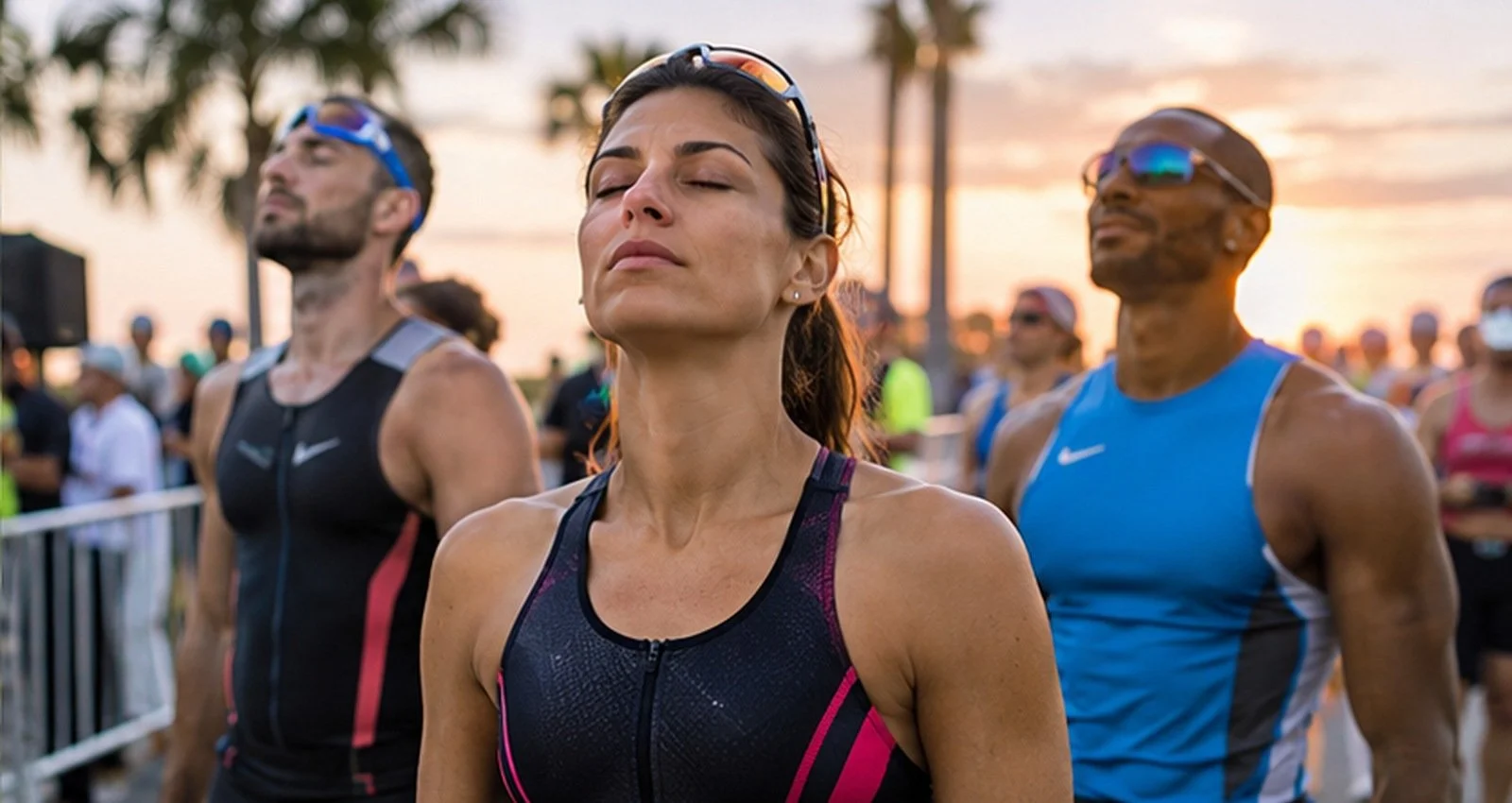
The starting line is physical and psychological
Months of training may leave a runner physically prepared but still feeling keyed up on race morning. Crowds, last-minute logistics and expectations can bring a quicker breathing rhythm, restless thoughts or an urge to rush. These reactions can be part of normal anticipation before an important event.
A physical warm-up prepares the body for movement. A 'Breath Up' is a different kind of preparation: a brief, comfortable breathing practice before competition that offers a moment to notice internal sensations, ease unnecessary tension and direct attention toward the race ahead. The aim is not to switch off or become sleepy.
Pre-race nerves are not the enemy
Feeling activated before a race is not necessarily a problem. Excitement and nerves can be present alongside readiness; the goal is not to eliminate them, but to respond with greater awareness. Research on slow breathing in generally healthy people has reported changes in autonomic measures and perceived relaxation, although results vary across studies. A small 2026 study of 34 adolescent amateur American football players observed changes in one aspect of pre-competition anxiety and in self-confidence during a program combining paced breathing, power posing and other psychological activities. Because the study followed a single group and combined several elements, it cannot establish an effect of breathing alone or be assumed to apply directly to runners.
These findings suggest that paced breathing is a reasonable skill to explore within a pre-race routine. They do not show that a particular breathing rhythm improves race times, or that athletes must feel completely calm to perform well.
Build the ritual before race day
A useful time to learn a breathing pattern is during training, not for the first time at the starting line. Try the same short session before a tempo run, long run or low-stakes race. Pair it with a familiar moment in your preparation, such as checking your gear or completing your warm-up. With repetition, the routine can become an easy-to-recognize cue to pause, notice and refocus.
Choose a breathing pattern that feels comfortable. Respa's Basic or Moderate tracks offer guided options, but there is no need to force a longer cycle or a difficult breath hold. The aim is to practice a manageable rhythm, not to achieve a perfect score.
Breath Up, then go
Think of Breath Up as a brief moment of attention alongside, rather than a replacement for, a physical warm-up. Finish the session, return to your natural breathing and continue your normal race preparation. You can carry that reminder to notice and refocus into the starting corral, whether some nerves remain or not.
Potential Benefits
Build a familiar, repeatable pre-race breathing ritual.
Create a simple point of focus when anticipation is high.
Practice noticing and gently adjusting breathing before competition, without needing to eliminate nervousness.
Ideal For
Runners who feel jittery before races.
Half-marathon and marathon participants.
Triathletes and other endurance athletes managing pre-event anticipation.
Where Respa Fits
For a Breath Up routine, Respa Mindfulness can help athletes rehearse a consistent breathing pattern during training rather than improvising it on race morning. Guided sessions provide a clear rhythm, while the wearable offers real-time feedback on how closely the user follows that pattern. This feedback reflects adherence to the guided breathing rhythm, not a measure of anxiety, race readiness or performance. Respa is a mindfulness and biofeedback tool; it does not measure oxygen, carbon dioxide, lung capacity, heart-rate variability, or diagnose a medical condition.
A Note on Safety
Practice only when stationary and when it is safe to pause. Avoid long or uncomfortable breath holds immediately before strenuous exercise. If a pattern causes dizziness, unusual breathlessness or discomfort, stop and return to natural breathing. Resume your usual breathing before the race begins.
References
Fernández-Barradas EY, Reynoso-Sánchez LF, Herrera-Meza S, López-Walle JM, Martínez-Moreno AG. Slow paced breathing and power posing: a pre-competitive ritual during an American football season. Front Sports Act Living. 2026;8:1800382. doi:10.3389/fspor.2026.1800382. PMID:42256048.
Zaccaro A, Piarulli A, Laurino M, et al. How Breath-Control Can Change Your Life: A Systematic Review on Psycho-Physiological Correlates of Slow Breathing. Front Hum Neurosci. 2018;12:353. doi:10.3389/fnhum.2018.00353.
Fincham GW, Strauss C, Montero-Marin J, Cavanagh K. Effect of breathwork on stress and mental health: A meta-analysis of randomised-controlled trials. Sci Rep. 2023;13:432. doi:10.1038/s41598-022-27247-y.