
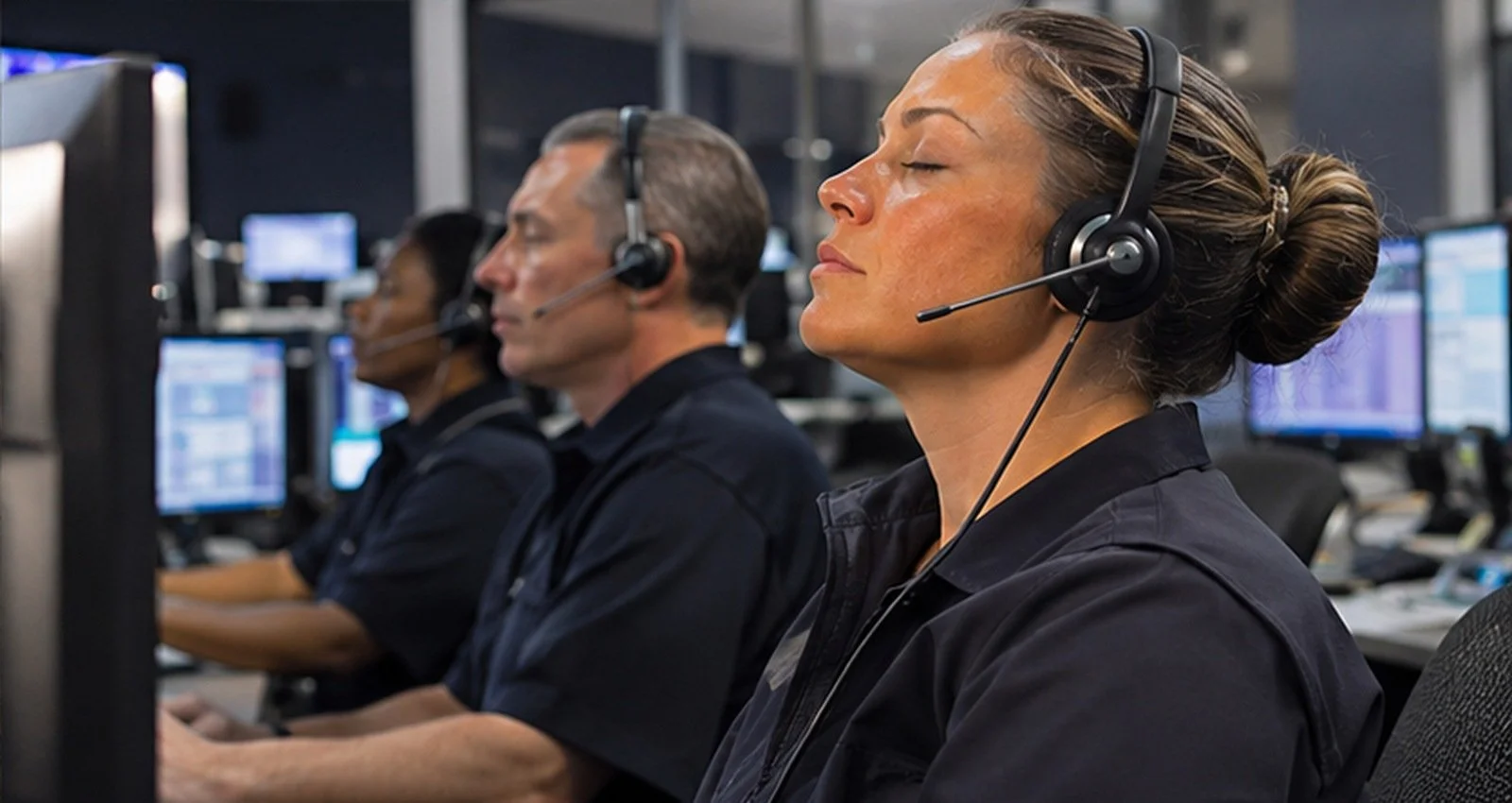
The radio can go quiet while the body stays activated
A difficult call may demand rapid decisions, sustained attention, and decisive action. That level of alertness can be useful during the incident. But the demands do not always stop when the call ends: another task may begin, a report may be due, or a responder may head home while still feeling keyed up.
Breathing cannot undo a difficult experience. When circumstances allow, however, a brief, intentional breathing practice may offer a way to pause, notice the body's response, and move into the next part of the shift with greater awareness.
Regulation is not the same as relaxation
Public-safety professionals cannot always relax deeply while on duty, and that is not necessarily the goal. Regulation means recognizing what is happening internally and responding in a way that fits the moment: remaining alert when needed, communicating clearly, and making space for a change in pace when circumstances permit.
Research in general adult populations suggests that some structured breathing practices can influence measures of autonomic activity and reduce self-reported stress, although findings vary across methods and studies. Research specific to first responders is more limited. These results should not be presented as proof that breathing prevents trauma symptoms or improves performance during emergencies.
The post-call window
After a difficult call, and only when operational conditions are safe, a responder might take a brief pause in a comfortable position, notice any tension in the jaw or shoulders, and follow an easy breathing rhythm for a minute or two. There is no need to force deep breaths, hold the breath, or reach a particular level of calm. Before returning to duty, the person can simply notice how they feel and what the next situation requires.
First-responder work also involves repeated demands that no individual breathing practice can resolve. Staffing shortages, trauma exposure, shift schedules, and organizational pressures require support beyond personal wellness routines. A short breathing pause may be useful when available, but it should remain an option rather than another expectation placed on personnel.
Train the transition before the worst call
A familiar routine may be easier to use during a demanding shift than a technique learned for the first time after a difficult call. Practicing briefly during lower-pressure moments allows each person to find a comfortable rhythm and decide whether it fits their needs and working conditions.
Potential Benefits
Recognize signs of lingering tension after a difficult call, such as hurried breathing or tightness in the shoulders and jaw.
Support attention before returning to reports or another task by using breathing as a brief, familiar point of focus.
Have a simple, practiced way to respond to moments of heightened activation when operational duties allow a pause.
Ideal For
Police officers, firefighters and EMS personnel.
Public-safety leaders building practical wellness routines.
Teams seeking brief practices that fit between operational demands.
Where Respa Fits
For public-safety professionals who choose to practice between operational demands, Respa Mindfulness offers guided breathing sessions and wearable feedback on how closely a user follows the selected breathing pattern. This feedback reflects the breathing exercise, not a measurement of stress, trauma, or readiness for duty. Respa is a mindfulness and biofeedback tool; it does not measure oxygen, carbon dioxide, lung capacity, or heart-rate variability, and it does not diagnose medical conditions.
A Note on Safety
Use guided breathing only when it does not interfere with driving, responding to calls, scene awareness, patient care, or other duties. Stop if the practice causes dizziness, discomfort, or unusual shortness of breath. Breathwork is not a substitute for peer support, professional mental-health care, trauma treatment, or emergency assistance. Persistent distress warrants appropriate agency or clinical support.
References
Perez RA, Jetelina KK, Reingle Gonzalez JM. The Chronic Health Effects of Work-Related Stressors Experienced by Police Communications Workers. Saf Health Work. 2021;12(3):365–369. doi:10.1016/j.shaw.2021.05.005. PMID:34527398.
Fincham GW, Strauss C, Montero-Marin J, Cavanagh K. Effect of breathwork on stress and mental health: A meta-analysis of randomised-controlled trials. Sci Rep. 2023;13:432. doi:10.1038/s41598-022-27247-y.
Keesee TL. Just Breathe: How Managing the Breath Helps Public Safety Make Mindful, Value-Driven Decisions at Work and at Home. Kendall Hunt; 2026.
Just Breathe podcast, hosted by Tracie Keesee. 2026.
Zaccaro A, Piarulli A, Laurino M, et al. How Breath-Control Can Change Your Life: A Systematic Review on Psycho-Physiological Correlates of Slow Breathing. Front Hum Neurosci. 2018;12:353. doi:10.3389/fnhum.2018.00353.
Balban MY, Neri E, Kogon MM, et al. Brief structured respiration practices enhance mood and reduce physiological arousal. Cell Rep Med. 2023;4(1):100895. doi:10.1016/j.xcrm.2022.100895.